In 2025, Nasim undertook an Honours year at the University of New South Wales, studying the archival erasures and repressions of First Nations people and South Asian Cameleers from the Victorian Exploring Expedition, otherwise known as the Burke and Wills Expedition.
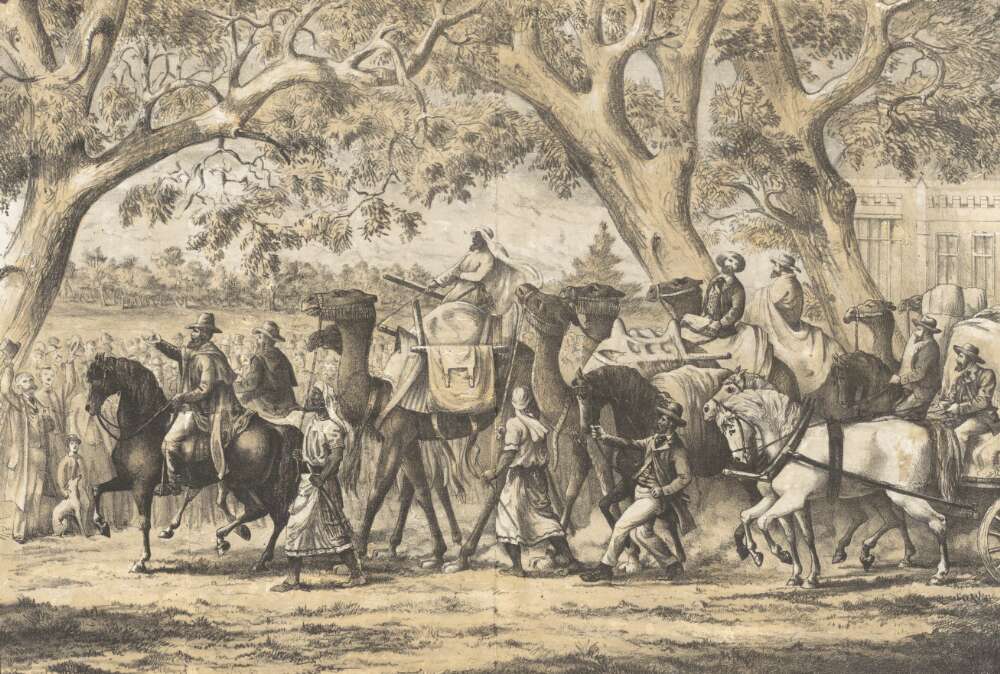
https://catalogue.nla.gov.au/catalog/258099.
The thesis is available upon request.
Abstract:
This thesis examines the production of the colonial imaginary through a reading of archival artefacts and contemporary monuments relating to the 1860-1 Victorian Exploring Expedition, more commonly known as the Burke and Wills Expedition. The expedition was the first European attempt to perform a south-to-north crossing of the Australian continent, an achievement made possible due to guidance from First Nations people and the first major importation of camels and Cameleers from South Asia. Much research has been done in studying the history of the expedition and its legacy on the national identity. However, few academic works have examined the intercultural encounters that took place between the European explorers and both First Nations people and Cameleers, as well as the lingering effects these encounters had on the developing racial grammar of the colony. In studying expedition records and archives, I argue that European racialisations of First Nations people and Cameleers worked to inflate the European explorers’ abilities, producing them as the prototypical figure of the ‘Aussie Battler’ and obscuring the colonial reliance on non-white labour. Such expedition records contribute to a colonial imaginary that figures Australia as an exclusively white possession. The thesis shows that explorers simultaneously relied on First Nations knowledge of Country and produced racialised representations that erased First Nations sovereignty. It also argues that Cameleers played an essential role in the interior between the 1860s-1930s, delivering goods and developing
infrastructures that further strengthened the colony and subjugated First Nations people. The thesis studies the erasure of this labour and its effect on First Nations people as a repression that later produced the damaging wild camel population as a ‘haunting’. In studying these racialisations, I argue that the colonial imaginary is a racialised imaginary. I further propose that excavating the
essential labour of First Nations people and the Cameleers unsettles the monolithic Australian identity within the colonial imaginary and provides potential solidarities to develop anti-racist futures.
